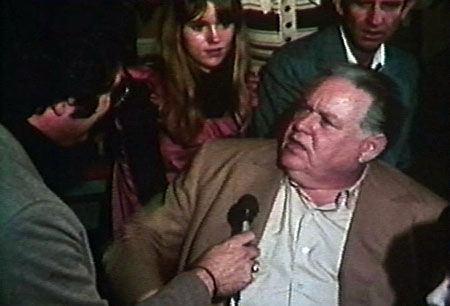
| 9-ball genius Luther Lassiter |
This is one of a series of pool history blogs hosted by author R.A. Dyer. Check back regularly for the newest interview excerpts, documents and other archival material related to pocket billiards history. For more information, visit www.poolhistory.com or the main Untold Stories pool history blog.
Sunday, November 7, 2010
Inflation-Adjusted Heart
Wednesday, July 7, 2010
Fats in Johnston City
Minnesota Fats was a fixture in southern Illinois during the 1960s, which was the heyday of the Johnston City tournaments and the pool revival I described in Hustler Days. The famous tournaments were created by George and Paulie Jansco, who are both members of the One Pocket Hall of Fame. I got to thinking about George and Paulie and Fats after receiving a letter the other day from Gary Carlson, a former graduate student from Southern Illinois. In it, Gary describes a chance encounter he had with Minnesota Fats. It was a small encounter, and yet the sort that appears to have taken on added meaning for Gary as he has learned more about Fats. That's because it quietly reflects some of the great qualities of Fats: he loved playing pool, he loved being around people and -- despite his hustler reputation -- there was a certain kindness about him.
Here's Gary's note:
From 1966 to 1969, I was a graduate chemistry student at Southern Illinois University in Carbondale, Illinois. I used to research my project from time to time during the wee hours and then go to a small hamburger place on the north side of Carbondale where they had 2 or 3 pool tables. I was usually the only one there and after a hamburger, I’d shoot some pool. I was only a fair player. One night (late 1968 – mid 1969), there was a guy sitting at the counter talking to the owner – I paid little attention to them. I had my hamburger, got a cue off the wall and began practicing.
Before long, the guy at the counter strolled over, watched a bit, and asked if I wanted to play a couple of racks. I said OK and asked if he wanted to bet a dollar a game. He laughed and said “A whole dollar”? I didn’t know if he was mocking me or couldn’t afford a dollar so I said “OK, how about 50 cents then”? He smiled and just said “Let’s play a bit for nothing and we’ll see what happens.” Well, he beat me several games with no trouble, shook my hand and left. The counter man said “Do you know who that was”? I told him I didn’t – and he told me it was Rudolph Wanderone – Minnesota Fats. I just said “Oh”. I had no idea who he was. Later, I saw a picture of him somewhere and realized who he was. Later still, I learned he was living not too far from Carbondale.
You asked for some remembrances of the man. That was mine. Recently I’ve read about him and from everything I understand, he was a pretty nice fellow.
Thanks to Gary. And, like he notes: I'm always looking for memories of the great ones. If you have one, send it in. If you'd like to learn more about Johnston City (or see another Johnston City video), check out my separate blog on the topic, which you can find here.
-- R.A. Dyer
Friday, April 9, 2010
Childhood home of Minnesota Fats
At the upper left is a photograph of the apartment building where Minnesota Fats grew up. It's in upper Manhatten, the neighborhood of Washington Heights. I managed to track down its location and take this photo during a trip to New York City in the summer of 2005. I knocked on the door but nobody was home. I used the research from that trip in The Hustler & The Champ, which also describes Fats' rivalry with Willie Mosconi. Some years later I made contact with one of Fats' nephews, Doug Corwin (shown at upper right), whose mother Bertha Wanderone lived with Fats at this home. Doug also provided me some really cool childhood photos of Fats, which you can find by clicking through this Untold Stories column.
-- R.A. Dyer
Friday, January 15, 2010
Fats vs. Mosconi: The Great Pool Shoot-Out
Sunday, December 13, 2009
Billiard Tales and Folklore
This is the second of a series of posts written in coordination with other online pool writers. It's part of the Pool Synergy project hosted this month by Samm Diep's pooltipjar.com. Look for more installments in the future.Our PoolSynergy topic this month is “Billiard Tales.” As part of my contribution I'm giving everyone an assignment. Find a poolroom in your area popular with the old timers and sidle up next to a few of them at the bar. It’s important that you find at least two or three of these guys sitting together. Four is even better. And I’m not talking about the middle-aged guys, I’m talking about the really old ones, the guys who have been around the pool halls 30 or 40 years at least.
Buy them a beer if you want, or just sit quietly. And then wait.
I guarantee you that within the first half hour you’ll start hearing stories of who took whom and for how much, or about the time some shark came to town, or about the big score by the local champ. Some stories will be verifiable, others not so much. I’ve even heard deadly serious tales of the supernatural.
To me, the form of these billiard tales is just as interesting as the content. That is, it's not what the stories are about, per se, but how they're communicated. The oral tradition is key. Most of the great old stories never get written down, never appear in newspapers -- and they grow in the telling. These stories pass from older players to younger ones, and as long as the community remains intact -- e.g., as long as the poolroom remains standing and the same men and women continue to frequent it -- the legends remain alive. Now here's a thought. Bear with me, but I think it's true. I believe these boozy recollections have a lot in common with the colorful stories that might get told by village elders around a camp fire. Listen to the old timers and you'll hear tales of heroes and villains and especially tricksters. Oral tradition (according to my quick research on Wikipedia) refers to the "transmission of cultural material through vocal utterance.” The oral traditional also has long been associated with folklore. I would argue that many of the stories told by old-time pool players are part of the folkloric tradition, but of an urban sort.
Some of my favorite Billiard Tales involve Minnesota Fats. In them Fats might be razzing an event promoter about the dress code, or cracking wise about the straight-laced "fun players," or gleefully robbing a tournament player during a high-dollar gambling session. These stories typically pits Fats against some symbol of the conservative billiards establishment.
As is the case with many trickster stories from folklore, Fats in these stories becomes an amoral and comic figure confronting the hypocrisy of the status quo. The billiards establishment would portray our sport as a clean-cut endeavor where no one ever gambles and where the dress code is strictly enforced. Minnesota Fats would portray it for what it really is. As a classic trickster, Fats confronts established authority, lies, and can act in amoral ways. But he also becomes an ironic symbol of truth.
I used to live in San Jose, Costa Rica. I remember hearing stories there about a hustler named “Pichitas” -- about how he would send well-dressed businessmen packing, or how he created this great shot from nowhere, or how he became a master of the 5 by 10s. I even remember the Pichitas "origin myth" -- in that stories were told about how he got his name (which, by the way, translates to “Tiny Dicks.”) These stories were told with something approaching reverence and at first I thought they were specific to Latin America. But I later discovered that they could have just as easily been told about Wimpy Lassiter or Jersey Red or U.J. Puckett. In each case, the players are portrayed as heroic or trickster figures, and in each case the stories are passed along directly through word of mouth. I also recognized in each case messages about the "culture" of the pool room, in that they would communicate lessons about such matters as gambling etiquette, attach value to certain sorts of figures and heap ridicule on others, and define the language common to members of the "tribe".
And so that brings us back to this month's assignment. Go sidle up to the bar, order a drink, and spend some time listening to the old timers. If you hear something good, remember it, and pass it along. Better yet, send me your stories and I'll post them up on this blog or use them as a fodder for a future Untold Stories column.
Some of the best Billiard Tales have never been written down. This puts them at risk for being lost forever. But through the magic of the Internet, we can now share the wisdom of our village elders with the world.
You can read a bit more about these ideas in The Hustler & The Champ. If you have your own old time story, send it to me at
hustlerdays@yahoo.com.
Monday, November 16, 2009
Introducting PoolSynergy: an online collection of pool writing

Check out the first edition of PoolSynergy, contemplated as a monthly collection of great pool writing from the web. Poolsynergy the brainchild of John Biddle, host of the www.poolstudent.com website. This month's theme is "Strategy,” and it features contributions from eight writers, including myself. Here's a brief description of these first contributions, with links to where you can find them.
*Samm Diep, well known for her blog The Tip Jar, talks about how she improved her game when she took another look at using the side pockets instead of the corners in her peice Corner vs. Side.
*Approaching the topic of strategy from a different perspective, Mike Fieldhammer, a BCA Certified Instructor,challenges conventional wisdom in Strategy: Should it Change Based on Your Opponent? Mike’s piece shows you how to gain an advantage at the table and win more often by taking your opponent’s abilities and style into account.
*In Offensive Safeties in 8 Ball (works only in IE), Joe Waldron makes clear that safeties aren’t just defensive shots when you have nothing else, but can play a strong offensive role as well. Waldron is the host of Pocket Billiards Review, which is always filled with insightful articles about the mental game.
*Also about strategy at the table, John Biddle’s article Thinking Your Way to More Pool Victories can help you raise your winning percentage. John is the man behind the PoolSynergy project.
*"FastMikie” McCafferty’s wise and insightful post The Impossible Dream talks about the role pool plays in your life strategy. Mike writes at Diary of a Pool Shooter, the longest continually running blog about pool.
*Gail Glazebrook’s post, The Deliberate Attack, gets you to think “How will I beat you” and then gives you an approach to follow that works for her. Gail’s blog is confessions of g squared.
*Mark Finkelstein, a BCA Certified Instructor and instruction columnist at the hot new pool website NYC Grind, helps you take an objective look at your game in his piece, Assessing Ability … On the Road to Effective Strategy.
*Melinda, in A Strategy to Manage the Mental Side of Your Game, helps us to keep our head in the game from the very beginning and recognize issues that need attention before it’s too late. Melinda, who calls herself a wanna-be pool player, lives and blogs in Texas at Pool is a Journey.
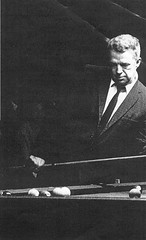
*I round out this month’s edition with my contribution, Minnesota Fats: The Quiet Thrashing. It's a story about several gambling sessions between Fats and Richie Florence, during several weeks in Johnston City back in 1970. That's an old picture of Fats at the top of this post.
Saturday, September 12, 2009
An interview with Karen Fox, widow of Minnesota Fats biographer Tom Fox
Karen Fox, widow of Tom Fox, attended the first Johnston City tournaments with her writer-husband in 1961. Both Karen and Tom worked at the Evansville Courier and Press, a newspaper published from the hometown of backroom legend Hubert "Daddy Warbucks" Cokes. Tom Fox would later help Minnesota Fats pen the "The Bankshot and Other Great Robberies," which was republished by Lyons Press in 2006. What follows is a partial transcript of various interviews with Karen Fox, the first conducted in August of 2000.
"Tom was a sports writer at the time, and he was a very good newsman, as well as being a good sports writer. Somebody called at the sports desk at the Evansville Sunday Courier and Press, and told him that this great Evansville Indiana pool player, Hubert Cokes, an oilman, was going to be participating in the tournament. They said that Tom, with his love for characters, should go to Johnston city, and watch Cokes play.
And this guy, on the phone, said that Cokes was a heavy money-player.
He and I had just started dating, and we had just seen The Hustler a couple of weeks before he got that call. He could not believe that out in the middle of nowhere, in Southern Illinois, were all these incredible pool players. They had this really good tournament room, with good acoustics, and bleachers, in the back. There was a concrete block room where, after the tournament was over, there were heavy-duty gambling. And Tom knew it was a national story.
We got to see it first hand. You know, television has a way of sterilizing stuff like that. ... But what we saw was pure, and raw, and real. There was a moment in time, a freeze frame, that we had that privilege to see. Those guys were incredible characters.
Oh my god, it was awesome. When tom started going over there, he took a bunch of us the 90 miles from Evansville. It was a drive. I worked at the paper too. We had just met. And he e took a whole load of us over there. He had a station wagon. It was so far, that (eventually ) everybody else stopped going, but I loved it."